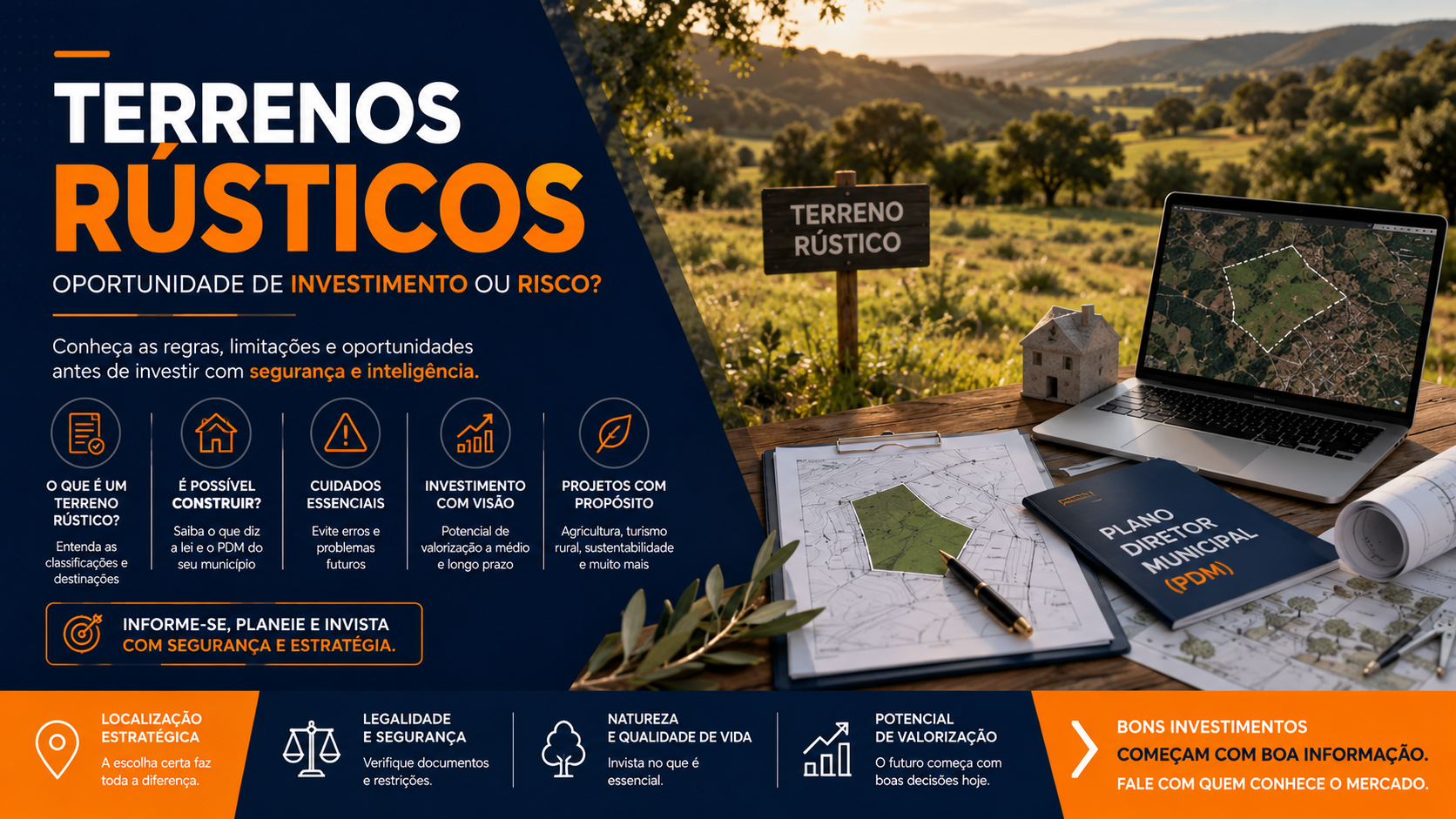
In recent years, rustic land has attracted increasing interest in Portugal. Whether for investment, agriculture, rural tourism or simply as a long-term asset, this type of property has been gaining prominence in the real estate market.
However, buying rustic land requires specific precautions. There are rules, limitations and legal details that can make all the difference between an excellent deal and a problematic investment.
Before you go ahead, it's essential to understand exactly what you're buying.
What is a rustic plot?
A rustic plot is a property intended primarily for:
- Agriculture
- Forestry
- Grassland
- Farming
- Rural activities
Unlike urban land, rural land has building limitations defined by the Municipal Master Plans (PDM) of each municipality.
This means that not all land allows housing to be built on.
Why is there so much demand for rustic land?
Today, many investors and buyers are looking for rustic land due to several factors:
More affordable prices
Compared to urban land, rustic land can have much lower values.
Growth potential
Some areas have been growing rapidly, especially regions with strong tourist demand or urban sprawl.
Interest in sustainable projects
There is a significant increase in demand for:
- Thursdays
- Rural tourism
- Organic farming
- Tiny houses
- Glamping
- Ecological projects
Seeking quality of life
Many families today are looking for quieter areas, with outdoor space and contact with nature.
Is it possible to build on rustic land?
This is the most frequently asked question - and the answer is: it depends.
Not all rustic land allows building.
It all depends on factors such as:
- Classification in the PDM
- Construction index
- Location
- Land area
- Access
- Available infrastructure
- National Agricultural Reserve (RAN)
- National Ecological Reserve (REN)
Before buying, you should always request:
Preliminary Information from the Town Hall
This document allows you to understand:
- What you can build
- Legal limits
- Urban indices
- Project viability
You should never buy land assuming that you will be able to build without official confirmation.
Essential precautions before buying
Buying rustic land requires a more technical analysis than many buyers realize.
Check the documentation
Confirm:
- Caderneta predial
- Land register
- Confrontations
- Actual areas
- Ownership
Confirming access
Land without legal access can become a serious problem in the future.
Analyze infrastructure
Check for:
- Water
- Electricity
- Sanitation
- Internet
- Access roads
Evaluating environmental restrictions
Land within protected areas may have very strict limitations.
Rustic land as an investment
Many investors today look at rustic land as a medium and long-term appreciation strategy.
Some advantages include:
- Lowest financial entry
- Lower competition
- Tourist potential
- Possible future urban development
However, it is an investment that requires strategic vision and patience.
How much does it cost to maintain rustic land?
Although they usually have a low IMI, there are other factors to consider:
- Mandatory cleaning
- Vegetation management
- Fire prevention
- Access maintenance
- Space security
In certain areas, failure to comply with cleaning rules may result in fines.
The impact of rural tourism in Portugal
The growth of nature tourism has increased interest in rustic land.
Projects linked to:
- Rural local accommodation
- Ecotourism
- Sustainable agriculture
- Natural experiments
continue to attract national and international investors.
Especially in regions such as:
- Silver Coast
- Alentejo
- Center of Portugal
- Northern Interior
Most common mistakes made by those buying rustic land
Buying without consulting the Câmara
One of the most serious mistakes.
Not validating the boundaries of the land
Many old properties have differences between documents and physical reality.
Ignoring legal restrictions
REN and RAN can prevent apparently simple projects.
Buying only at a low price
Expensive land is not always a good opportunity.
Is it worth investing in rustic land?
For many investors, yes.
But success depends on:
- Location
- Investment objective
- Legal viability
- Future strategy
- Professional follow-up
With the growing demand for natural spaces and sustainable projects, rustic plots can represent excellent opportunities when analyzed correctly.
Do you need help on this topic?
Leila Santos
Real Estate Consultant - MaisConsultores TEAM
📍 Silver Coast
📱 +351 914 930 347
✉️ leilasantos@maisconsultores.pt
🏢 AMI: 23990